What is the Desert Healthcare District?
A local government agency working to achieve optimal health at all stages of life for every resident of the Coachella Valley.
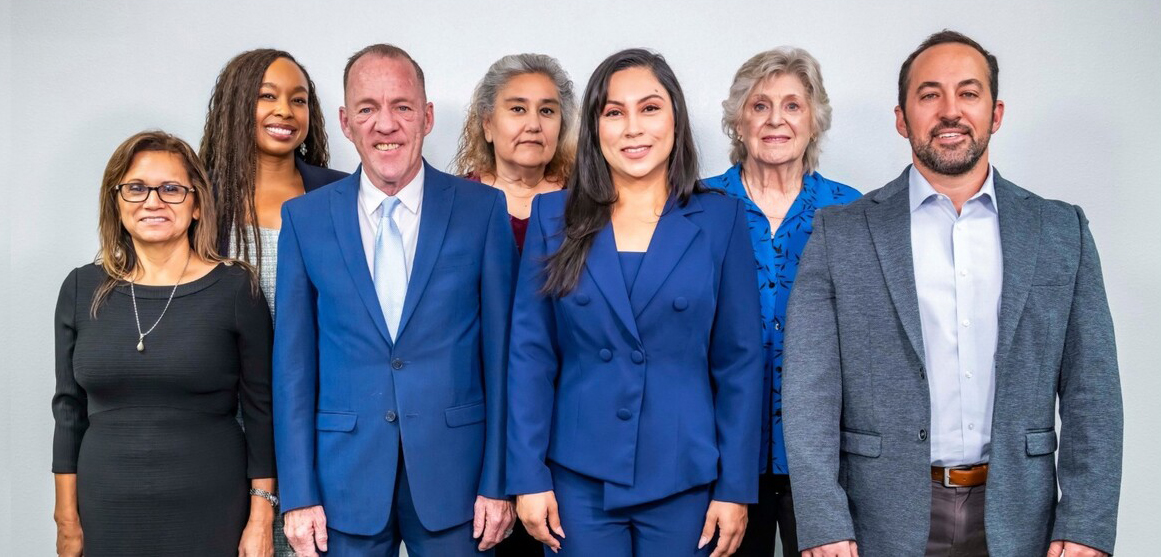
The Desert Healthcare District & Foundation Board of Directors.
The Desert Healthcare District & Foundation is a local government agency whose mission is to optimize health at all stages of life for District residents. Its boundaries span the entire Coachella Valley, home to more than 400,000 people.
The District was formed in 1948 to build a hospital in Palm Springs and improve access to care in the desert. It ran Desert Hospital as a nonprofit for many years and established its Foundation in 1967. Today the District is primarily a grantmaking organization, and together with the Foundation it is one of the largest funders in the Valley, having awarded more than $100 million to help residents, especially the underserved, reach primary and behavioral healthcare and other vital resources.
How the District is funded
The District draws revenue from several sources. The primary one is a small share, less than one percent, of Riverside County property taxes collected each year from western Coachella Valley residents, which averages roughly $10 to $11 million a year. The District also receives revenue from the Las Palmas Medical Plaza in Palm Springs.
The hospital, Tenet, and Measure AA
The District owns Desert Regional Medical Center, formerly Desert Hospital. It is a 360-bed facility with tertiary acute, critical care, and skilled-nursing services. Tenet Healthcare has operated the hospital under a 30-year lease since 1997, and that lease was set to expire on May 30, 2027.
In September 2023, Tenet proposed a Lease-Purchase Agreement (LPA) that would extend its lease from 2027 to 2057, after which ownership of Desert Regional would transfer to Tenet. Following nearly a year of negotiations and 11 public forums, the District Board voted on August 6, 2024 to place the agreement before voters as Measure AA on the November 5, 2024 ballot.
Coachella Valley voters approved Measure AA, with roughly 71% in favor. The decision keeps hospital care running uninterrupted and moves the District into a new chapter, one focused on reimagining its role across the wider health system.
Total Tenet will pay the District over the 30-year agreement.
Initial payment on the first day of the new lease in 2027.
Lease end, when ownership transfers to Tenet with a final $100M payment.
State seismic-compliance deadline Tenet commits to meet, without valley taxpayer support.
A new 5-year strategic plan
With the hospital’s future settled, the District adopted a new 2027–2031 strategic plan that reimagines the agency’s role as a health system amplifier. The goal is not only to fund care but to strengthen the entire regional system. The plan organizes its work around workforce development, awareness and access, engagement, and data-driven decisions.
Frequently asked questions
Does the District own Desert Regional Medical Center?
Yes. The District owns the medical center, which has 360 beds along with tertiary acute, critical care, and skilled-nursing services. Tenet Healthcare has operated it since 1997.
What did the Lease-Purchase Agreement propose?
It extends Tenet’s lease of Desert Regional from 2027 to 2057, with ownership transferring to Tenet at the end. In total Tenet pays the District about $650 million: a $100 million payment in 2027, annual installments of more than $20 million over 20 years, and a final $100 million payment in 2057.
Does Tenet operate other hospitals in the area?
Yes. Tenet owns JFK Memorial Hospital in Indio and leases Hi-Desert Medical Center in Joshua Tree from the Morongo Basin Healthcare District.
What about the state’s seismic mandates?
Under the agreement, Tenet maintains the hospital’s seismic compliance without requiring support from valley taxpayers. State law requires that work to be completed by 2030.
Could Tenet sell the hospital before 2057?
The agreement includes restrictions to protect the District’s lease revenue, including limits during the first 10 years on who Tenet could sell to. Any buyer would have to be financially secure enough to continue payments and complete the mandated seismic work on the state’s timeline.
What is the noncompete clause?
The clause says the District will not make grants for projects that support a competing business or generate substantial revenue for another acute-care hospital in the District. It also carries important exceptions. The District can still fund projects run by Federally Qualified Health Centers, community service organizations, or acute-care hospitals outside the District, including urgent care, psychiatric, skilled-nursing, and drug-treatment facilities.
In the Valley’s highest-need areas, which include the medically underserved communities plus several designated areas such as Desert Hot Springs, there are no restrictions on who the District can rent to, including an acute-care hospital.